EDI (Electronic Data Interchange)

Yet, for all its fearsome appearance in flight, the Ogre Darner’s true vulnerability lies in the mud. It is a species defined by a single, ephemeral habitat: the perched swamp. These are acidic, nutrient-poor bogs that sit above the surrounding water table, fed only by rain. Unlike most dragonflies, which lay their eggs in flowing streams or ponds, the female Ogre Darner uses a scimitar-like ovipositor to drill into the sopping peat of these swamps, depositing her eggs deep within the saturated sphagnum moss. The larvae—voracious, flattened ambush predators—spend up to five or six years in this dark, tannin-stained water, growing slowly in the cool, stable environment. They are not swimming nymphs; they are burrowers, lying in wait for passing invertebrates and even small frogs.
That protracted childhood is the species’ greatest weakness. It takes nearly a decade for an Ogre Darner to transform from an egg into a winged adult, which will live for only a few fleeting months. This slow maturation means the population cannot quickly recover from disaster. And disaster is mounting. The perched swamps of the Wet Tropics of Queensland are under siege from climate change. Reduced rainfall and rising temperatures dry out the peat, preventing females from drilling into the hard, cracked soil. Without saturated moss, there is no nursery. The Ogre Darner is effectively being starved of its own birthright. ogre darner
In the shadowy, waterlogged rainforests of northeastern Australia, a predator lurks that seems to have slipped through a rift in time. It does not roar, nor does it stalk on four legs. Instead, it patrols the forest understory on four translucent, buzzing wings. This is the Ogre Darner ( Petalura ingentissima ), one of the largest and most enigmatic dragonflies on Earth. To call it merely a big insect is to mistake its true nature; it is a living archive of an ancient world, a relic of a time when oxygen-rich skies allowed arthropods to grow to monstrous sizes. In the Ogre Darner, we see not just a predator, but a fragile guardian of a disappearing ecosystem. Yet, for all its fearsome appearance in flight,
In the end, the Ogre Darner teaches us a lesson about scale. It is easy to rally behind the conservation of cuddly marsupials or charismatic birds of paradise. But the loss of this “ogre” would be no less tragic. It represents an unbroken lineage of predation and adaptation stretching back to before the dinosaurs. To lose the Ogre Darner is not merely to lose a species; it is to sever a living link to the deep past, to silence one of the last echoes of the age of giant insects. In the fate of this monstrous, magnificent dragonfly lies a simple truth: in the age of humans, even ogres are fragile. Unlike most dragonflies, which lay their eggs in
The conservation status of Petalura ingentissima is officially listed as “Near Threatened,” but many entomologists argue this is dangerously optimistic. Its habitat is hyper-fragmented, existing in small, isolated pockets from Cooktown to Townsville. A single severe El Niño event, a prolonged drought, or a runaway wildfire could erase several of these populations forever. Because the adults are strong fliers, they can travel between swamps, but if the swamps themselves vanish, the species becomes a ghost—a few robust adults buzzing over a desiccated wasteland with nowhere to lay their eggs.
The first encounter with an Ogre Darner is startling. With a wingspan that can exceed 160 millimeters (over six inches) and a body as thick as a human finger, it evokes the giant dragonflies of the Carboniferous period, the griffinflies that reigned 300 million years ago. Its common name derives from its bulbous, multifaceted eyes—massive compound lenses that meet at a single point on top of its head, giving it an almost monstrous, helmeted visage. These are not aesthetic quirks; they are tools of an apex aerial predator. The eyes grant near-360-degree vision, allowing it to snatch smaller insects, including other dragonflies, from the air with a 97% hunting success rate. It is a carnivore of devastating efficiency, a hawk of the insect world.

EDI can often be a complex and confusing concept for first-timers. It doesn't help when the commercial EDI vendors leave you dazed and confused by flooding the market place with convoluted and unnecessary sales jargon that in fact you don't actually need. So, if you're in the trucking, manufacturing, or healthcare business and you're looking for a sensible bare-bones EDI solution then by all means reach out to us at the email contact below. We will get you on the right track. The advise and conversation is free to all.
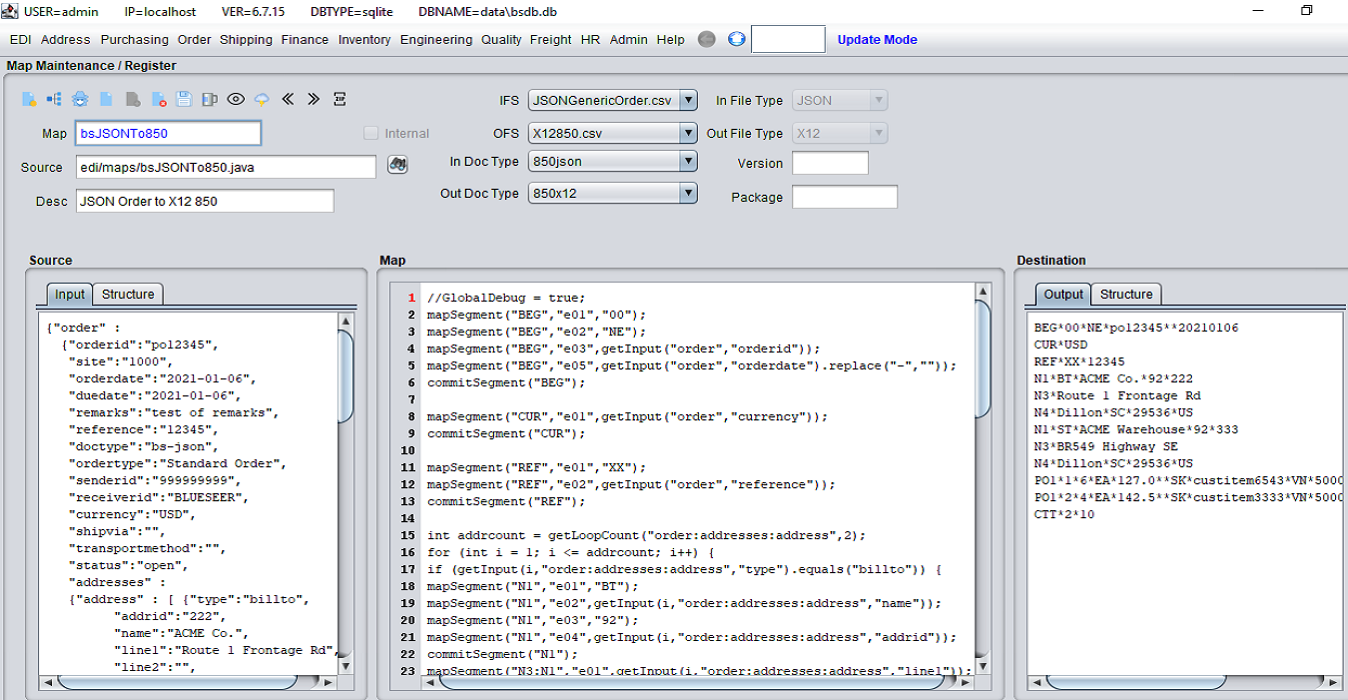
BlueSeer provides EDI software solutions for all of these by providing a free open source EDI package that can be downloaded and installed...completely free. Whether you're in the Manufacturing, Transportation, Insurance, or Health Care services, you can create your own maps for your EDI transactions and exchange EDI documents with your Trading Partners via the built-in SFTP, AS2 communication methods simply from the application you download and install with BlueSeer. The application provides you with all the tools necessary to implement an on-premise solution on your own server. There are plenty of sample maps and tutorials to get you moving in the right direction. Or, you can use our EDI mapping, consulting, and implementation services to get you started. We also offer a managed hosting solution where we host the EDI translation, configuration and communication (AS2, SFTP) within a cloud hosted enviroment. Reach out to the contact email below for more information and/or to set up a quick conversation regarding your requirements.
BlueSeer supports several high profile communication methods used in today's EDI solutions. The more predominant method is AS2. AS2 is a complex transport protocol that provides EDI trading partners the ability to exchange EDI document types in a secure and reliable manner and provide a level of transmission gaurantee per the mechanics of the exchange. AS2 is the lowest cost approach to EDI communication as it does not require middleware VAN mailboxing services. BlueSeer is one of only a few free open source AS2 packages available. BlueSeer's AS2 option provides a completely free EDI AS2 on-premise solution to engage the AS2 protocol with your EDI trading partners and bypass the costly VAN mailbox and web services. It only requires the installation of BlueSeer and an internet connection. Other EDI communication protocols include FTP as well as sFTP using the SSH File Transfer Protocol. All of these support communication methods are bundled as a free EDI communication package. For more information on the technical details of AS2 visit the specs page here.
BlueSeer has an embedded free EDI translation mapping editor that comes standard with the installation of BlueSeer. This translation tool provides the application with a method to transform EDI documents from one format to another. The mapping editor can accomodate translation for EDI X12, Edifact, CSV, JSON, XML, and flat file (IDOC, etc) formats. BlueSeer can act as a standalone EDI translator (mapping from one format to another) or as an integrated EDI / ERP solution where the inbound EDI documents are transformed into standard ERP table records (Sales Orders, Shipping documents, etc). The default installation comes with a variety of pre-built maps that can translate between the below formats. These maps are free to use and to extend/customize as necessary and can be used as examples for more complex mappings. There are plenty of examples of transaction maps that are commonly found in manufacturing/business markets such as 850, 810, 856, 855, 820, 204, etc.
BlueSeer provides convenient methods for creating Trading Partner, defining unique Flat File formats, and establishing unique input / output destination directories. Novel document types can be created and customized as well with the Document Recognition rules engine.
BlueSeer provides a variety of reporting options to track individual EDI documents as they are processed by the embedded EDI engine. Transactions can be monitored for success/failures with optional retry capability. Documents can also be tracked by key field searching options.