Kerio Control Offline - License File !!install!!
From a security and reliability perspective, the offline license file offers clear advantages. It eliminates the risk of a licensing outage due to a vendor’s server downtime or a DNS failure. It also prevents any potential data leakage through license-beaconing mechanisms, since no outbound validation traffic ever occurs. However, it has notable limitations: offline licenses typically cannot support subscription-based services that require real-time updates, such as antivirus signature updates, web filtering category lookups, or intrusion detection rule sets. Therefore, an offline license is best suited for organizations that need basic firewalling, VPN, and static content filtering, or for those that can manually update these components via other offline means.
In the realm of network security, the Unified Threat Management (UTM) appliance Kerio Control (now part of GFI Software) is widely respected for its balance of enterprise-grade features and ease of use. While modern software licensing increasingly relies on persistent internet connectivity and cloud-based authentication, certain operational environments demand isolation. For these scenarios, the Kerio Control offline license file is not merely an alternative—it is an essential component for maintaining legal, functional, and secure network operations. kerio control offline license file
In conclusion, the Kerio Control offline license file represents a mature, security-conscious approach to software licensing. It acknowledges that not all networks can—or should—maintain continuous vendor connectivity. By decoupling license validation from internet access, GFI empowers administrators to deploy robust perimeter security in even the most sensitive and isolated environments. For any team managing a Kerio Control firewall in a closed network, understanding and utilizing the offline license file is not a niche skill; it is a fundamental pillar of operational resilience. From a security and reliability perspective, the offline
An offline license file is a cryptographically signed text file provided by the vendor that, when manually uploaded to a Kerio Control firewall, validates the product’s right to operate without requiring real-time communication with GFI’s licensing servers. This mechanism is crucial in several contexts. First, government, military, and critical infrastructure networks often operate under "air-gapped" conditions, where no internet connection is permitted for security reasons. Second, some organizations place their firewall in a DMZ or behind another upstream firewall that may inadvertently block the outbound license validation traffic (typically on TCP port 443 to specific GFI domains). Third, during troubleshooting or when temporary network outages occur, an offline license prevents the firewall from reverting to an unlicensed state, which could interrupt traffic flow. offline method (e.g.
Obtaining and applying the offline license file requires a deliberate, secure process. The administrator must first generate a unique (derived from the system’s network interfaces and storage) from the Kerio Control console. This fingerprint is then transferred via a secure, offline method (e.g., an encrypted USB drive) to an internet-connected workstation. Using that fingerprint, the administrator logs into the GFI customer portal, requests an offline license, and downloads a .lic file. Finally, the file is manually imported back into the Kerio Control interface. This process ensures that the license is irrevocably tied to a specific hardware instance, preventing unauthorized copying or use on multiple devices.
Prophets In Quran & Their Ancestry
A Journey Through Revelation - Unveiling The Prophetic Legacy
Read More
Quran Explorer
Our well known Web client for Recitation & Translation. Its user friendly & completely installation free
Visit Now





Nikah Explorer
NikahExplorer.com is the #1 choice for Single Muslims across the globe to find their ideal life partner through a unique Shariah compliant match making website
Register For Free




New Quran Explorer Web App
Compatible with your new Tablet & Smartphone along with advance log in & tracking feature
Visit Now

Salah Explorer
- Auto detect local Salah times
- Salah time view in 5 or 30 days interface
- Location based Qibla direction
- Both Islamic and Georgian calendar
- Salah timings for Hanfi & Shafi
- Custom location settings
- Automatically updates when connected
Download


iPhone / iPad App
Simple to use with high quality audio. Your favorite Quran reading application is now available for iPhone & iPad with lots of new features
Visit App Store
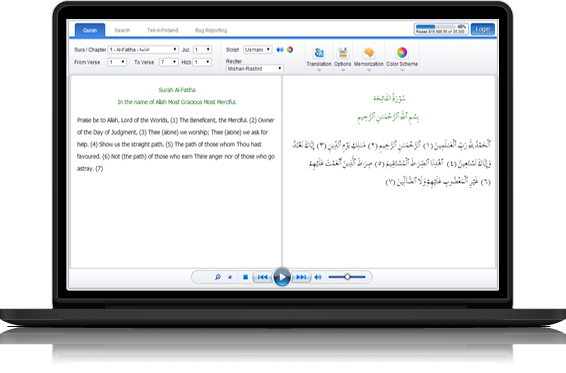
Quran Desktop
Listen to The Quran recitation & translation in Arabic, English and Urdu. This application is now available in both online & offline modes
Get Desktop App

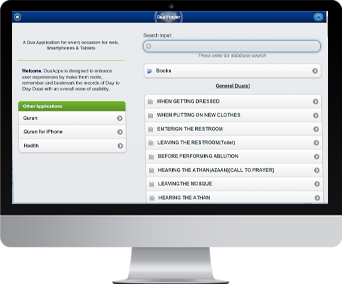
Dua App
Four popular Dua books digitized and searchable containing 1000+ Duas (Supplications) for daily use or special circumstances. Designed to be optimized for Tablets, Smart Phones, and Desktop
Visit Now

Quran Interactive
Learn to read The Holy Quran online with professional teachers. Join hundreds of people that are benefiting from our advance teaching system
Sign up now for a 2 days FREE trial evaluation
Sign UP Now
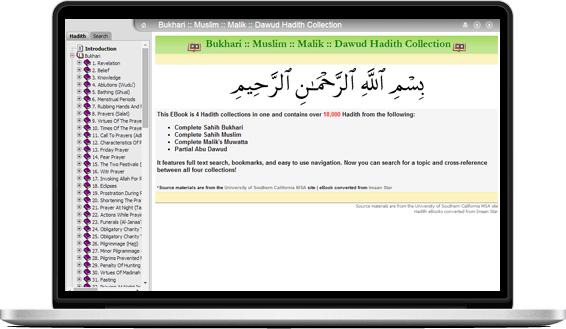
Hadith Explorer
18,000+ Hadith from Bukhari, Muslim, Malik and Dawud searchable & organized in easy to view chapters
Visit Now
From a security and reliability perspective, the offline license file offers clear advantages. It eliminates the risk of a licensing outage due to a vendor’s server downtime or a DNS failure. It also prevents any potential data leakage through license-beaconing mechanisms, since no outbound validation traffic ever occurs. However, it has notable limitations: offline licenses typically cannot support subscription-based services that require real-time updates, such as antivirus signature updates, web filtering category lookups, or intrusion detection rule sets. Therefore, an offline license is best suited for organizations that need basic firewalling, VPN, and static content filtering, or for those that can manually update these components via other offline means.
In the realm of network security, the Unified Threat Management (UTM) appliance Kerio Control (now part of GFI Software) is widely respected for its balance of enterprise-grade features and ease of use. While modern software licensing increasingly relies on persistent internet connectivity and cloud-based authentication, certain operational environments demand isolation. For these scenarios, the Kerio Control offline license file is not merely an alternative—it is an essential component for maintaining legal, functional, and secure network operations.
In conclusion, the Kerio Control offline license file represents a mature, security-conscious approach to software licensing. It acknowledges that not all networks can—or should—maintain continuous vendor connectivity. By decoupling license validation from internet access, GFI empowers administrators to deploy robust perimeter security in even the most sensitive and isolated environments. For any team managing a Kerio Control firewall in a closed network, understanding and utilizing the offline license file is not a niche skill; it is a fundamental pillar of operational resilience.
An offline license file is a cryptographically signed text file provided by the vendor that, when manually uploaded to a Kerio Control firewall, validates the product’s right to operate without requiring real-time communication with GFI’s licensing servers. This mechanism is crucial in several contexts. First, government, military, and critical infrastructure networks often operate under "air-gapped" conditions, where no internet connection is permitted for security reasons. Second, some organizations place their firewall in a DMZ or behind another upstream firewall that may inadvertently block the outbound license validation traffic (typically on TCP port 443 to specific GFI domains). Third, during troubleshooting or when temporary network outages occur, an offline license prevents the firewall from reverting to an unlicensed state, which could interrupt traffic flow.
Obtaining and applying the offline license file requires a deliberate, secure process. The administrator must first generate a unique (derived from the system’s network interfaces and storage) from the Kerio Control console. This fingerprint is then transferred via a secure, offline method (e.g., an encrypted USB drive) to an internet-connected workstation. Using that fingerprint, the administrator logs into the GFI customer portal, requests an offline license, and downloads a .lic file. Finally, the file is manually imported back into the Kerio Control interface. This process ensures that the license is irrevocably tied to a specific hardware instance, preventing unauthorized copying or use on multiple devices.