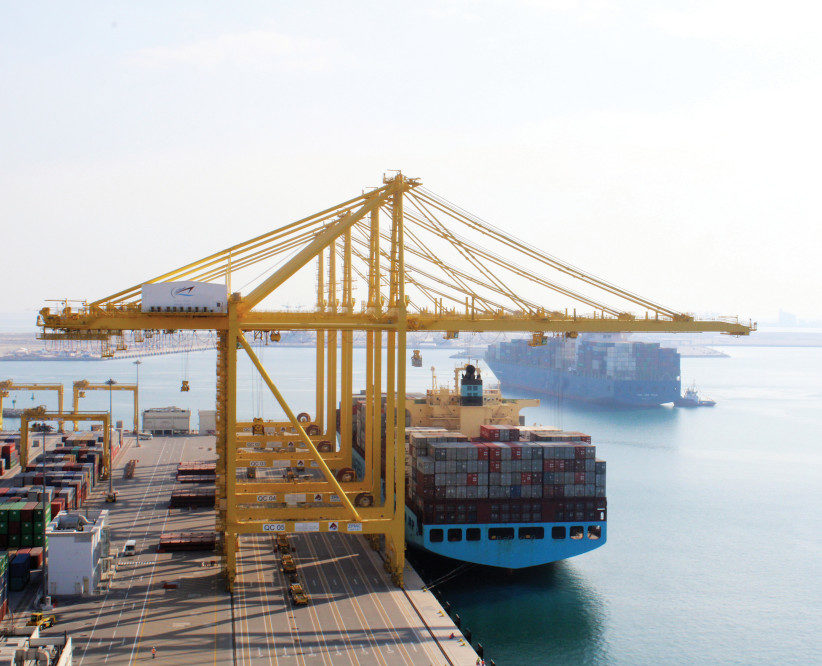
QTerminals is a terminal operating company jointly established by Mwani Qatar (51% shareholding) and Milaha (49% shareholding) to provide container, general cargo, RORO, livestock and offshore supply services in Phase 1 of Hamad Port, Qatar’s gateway to world trade.
QTerminals is responsible for enabling Qatar’s imports and exports, its maritime trade flows and stimulating economic growth locally and regionally. QTerminals was awarded the concession for the design, development and operations of Hamad Port’s Phase II (Container Terminal 2) in November 2018 by Qatar’s Ministry of Transport and Communications. We are also actively identifying investment and operations opportunities in ports and terminals outside of Qatar.
QTerminals established as a JV between Qatar Ports Management Company (Mwani Qatar – 51% shareholding) and shipping and logistics company Qatar Navigation (Milaha – 49% shareholding) in 30 November 2017 to handle Containerized and Non- Containerized (General Cargo, Bulk, RORO, Live Stock, Off Shore Supply).
Commenced operation at Hamad Port in Dec 2016.
2017
The official inauguration of the Hamad port took place on the 5th of September 2017 under the auspices of HH the Emir Sheikh Tamim bin Hamad Al Thani.
2018
Concession of design, develop and operate Phase II (Container Terminal 2) of Hamad Port awarded to QTerminals in Nov 2018.
2019
MUT, OST, and GCT Yard Extension taken over in May 2019.
Implementation of NAVIS N4 TOS for the Container Terminal 1 in August 2019.
2020
Start of operations at Container Terminal 2 (CT2) in December 2020.
2021
Milestone of 6M TEUs handled in 2021.
Milestone of 13M TEUs of Non – Containerized Cargo handled in 2021
5d Chess May 2026
The game’s most revolutionary rule is simple: A rook, for example, can move any number of squares forward in time (to a future turn on the same board) or backward in time (to a previous turn). When a piece travels back in time, it does not erase the original timeline. Instead, it creates a branch —a new, parallel timeline that diverges from the moment of arrival.
For instance, if on turn 5, a player sends a knight back to turn 3, the game creates a new board representing “Timeline B, Turn 3.” The original timeline (Timeline A) continues onward from turn 5 simultaneously. The player now controls pieces on multiple boards across multiple timelines, and pieces can move not only within their own timeline but also laterally between parallel boards. This creates a growing “multiverse tree” of interconnected games. Despite the chaos, the win condition remains elegant: checkmate any king in any timeline. However, this single goal interacts with the multiverse in complex ways. If a player creates a branch timeline where their opponent’s king is checkmated, they win instantly—even if their own king is checkmated in another branch. This introduces the concept of “temporal defense”: a player might sacrifice their king in one timeline to create a distracting branch, or move a piece from a doomed board to reinforce a vulnerable king elsewhere. 5d chess
For over a millennium, chess has served as a perfect metaphor for strategic conflict, bounded by immutable laws: two dimensions, one timeline, and a linear progression of moves. Then, in 2020, the independent game 5D Chess with Multiverse Time Travel shattered these conventions. Far from a mere novelty, this game redefines the very fabric of combinatorial strategy by introducing parallel timelines, time travel, and multidimensional movement. This essay explores the core mechanics of 5D Chess , its profound strategic implications, and its value as a thought experiment in non-linear logic. The Mechanics of a Fracturing Timeline To understand 5D Chess , one must first abandon the traditional chessboard. A standard game occupies a single plane (x- and y-axes) over a single temporal line (the t-axis). 5D Chess adds two additional dimensions: the ability to move pieces into parallel timelines (the z-axis of alternate realities) and the ability to travel backward to earlier points in the primary timeline. The game’s most revolutionary rule is simple: A
This website uses cookies to improve your experience while you navigate through the website. Out of these cookies, the cookies that are categorized as necessary are stored on your browser as they are as essential for the working of basic functionalities of the website. We also use third-party cookies that help us analyze and understand how you use this website. These cookies will be stored in your browser only with your consent. You also have the option to opt-out of these cookies. But opting out of some of these cookies may have an effect on your browsing experience.
This website uses cookies to improve your experience while you navigate through the website. Out of these cookies, the cookies that are categorized as necessary are stored on your browser as they are as essential for the working of basic functionalities of the website. We also use third-party cookies that help us analyze and understand how you use this website. These cookies will be stored in your browser only with your consent. You also have the option to opt-out of these cookies. But opting out of some of these cookies may have an effect on your browsing experience.
Necessary cookies are absolutely essential for the website to function properly. This category only includes cookies that ensures basic functionalities and security features of the website. These cookies do not store any personal information.